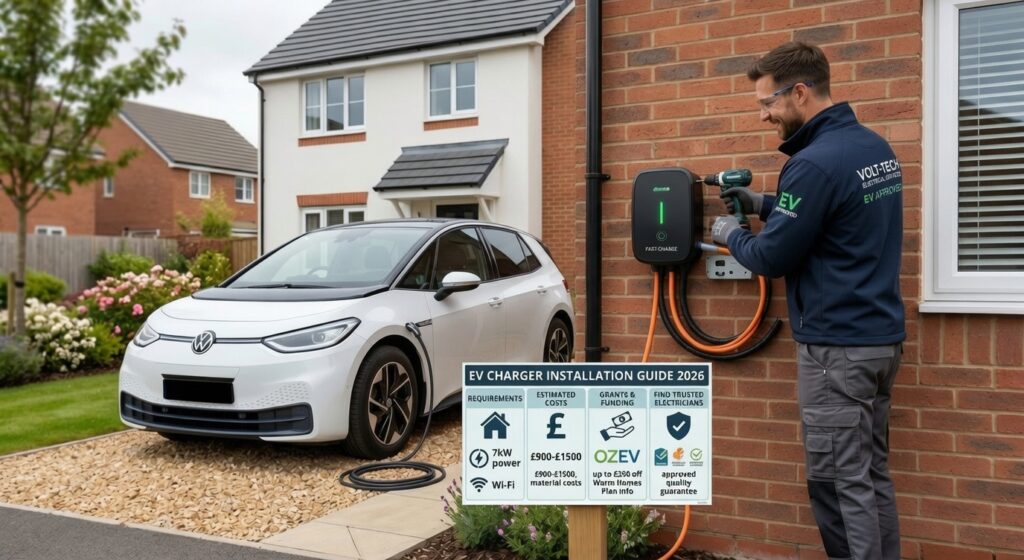
Current grants (from April 2026)
The main support is the EV Chargepoint Grant administered by the Office for Zero Emission Vehicles. From 1 April 2026 the maximum grant rose to £500 per socket (covering up to 75 percent of the combined hardware and installation cost). The schemes run until 31 March 2027.
Eligibility is limited. The grant is primarily available to:
- Renters
- Flat owners
- Landlords (with higher limits on the number of sockets)
- Certain households with on-street parking arrangements
Most homeowners who live in houses with private off-street parking do not qualify for the residential grant. Always check the latest rules on GOV.UK before proceeding, as eligibility and application processes can change.
To claim the grant you must use an OZEV-approved installer and an approved charger model. The installer usually handles the claim process.
Technical and regulatory requirements
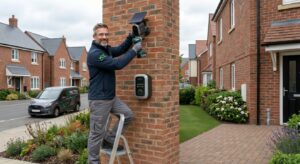
Installation must be carried out by a suitably qualified electrician. Key points include:
- Compliance with BS 7671 (IET Wiring Regulations) and Part P of the Building Regulations
- A dedicated circuit from the consumer unit in most cases
- Adequate electrical capacity; some older properties need an upgrade first
- For grant-funded work, the installer must be OZEV authorised
- The charger itself should be a smart model that meets current standards if you want grant support
Planning permission is rarely required for a standard wall mounted charger on a private driveway, but listed buildings and conservation areas can have additional restrictions. Check with your local authority if you are unsure.
What the installation process looks like
- Initial enquiry and desk-based assessment of your property
- Site survey (often free or low cost) to check electrical capacity, cable route and mounting position
- Quote that clearly sets out the work and any extras
- Booking and, if claiming a grant, the necessary paperwork
- Installation day, typically taking a few hours for a standard job
- Testing, certification and handover of the paperwork
Most straightforward installations are completed in half a day once the survey is done and parts are available.
Choosing a charger and an installer
Look for a smart charger that can schedule charging for off-peak tariffs and, if relevant, integrate with solar or battery storage. Popular and reliable options in the UK market include models from Ohme, myenergi, Hypervolt, Easee, Wallbox and similar established brands.
When selecting an installer:
- Confirm they are Part P registered and, if you need the grant, OZEV approved
- Check recent reviews and examples of similar work
- Ask whether they carry out their own surveys or rely on desk assessments
- Request a written quote that itemises the charger, labour and any electrical upgrades
- Confirm the warranty on both the unit and the installation work
Local experience can be useful, particularly with older housing stock where consumer unit upgrades are more common.
Practical tips
- Charge on a smart overnight tariff once the unit is installed. The difference in cost per mile compared with public rapid chargers is significant.
- If you have or plan solar panels, choose a charger that can divert surplus generation.
- Keep the installation certificate and any grant paperwork safely. They may be needed for insurance or when selling the property.
- Avoid using non-approved installers if you intend to claim any grant. It will usually invalidate the claim.
Ready to Install Your EV Charger?
Don’t leave your installation to chance. Connect with vetted, OZEV-approved electricians specialising in EV charger projects through Leedle.co for personalised quotes, grant assistance, and expert service. Start enjoying convenient, affordable home charging today with trusted professionals in your area.